What to do in the first hour when a tenant's heat goes out
A calm order of operations for a cold night, from safety checks to the repair call, with the Minnesota rules that apply.
· 4 min read
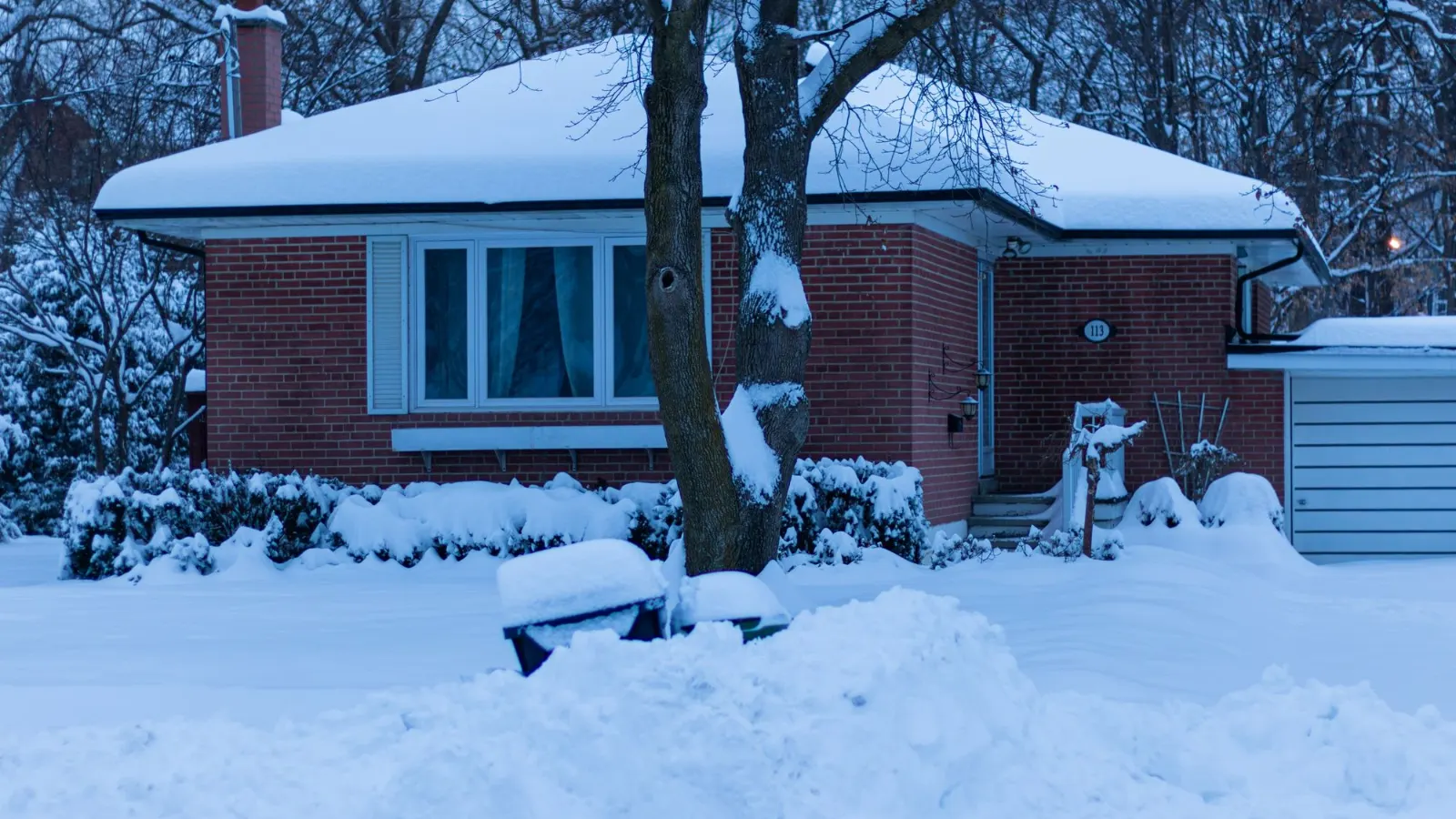
Say it's a Tuesday night in January. Your tenant texts that the house is cold, the furnace is quiet, and the thermostat reads 61. In the next few minutes you're deciding whether this is a safety call, a five-minute fix, or a job for the HVAC company.
Plenty of no-heat calls turn out to be small. Dead thermostat batteries, a furnace switch someone flipped thinking it was a light, a filter so packed with dust the furnace shuts itself off. But you want to rule out the dangerous causes before you start troubleshooting, and in roughly this order.
Start with safety
Ask two questions first. Does anyone smell gas? Is a carbon monoxide alarm going off, or does anyone feel dizzy, sick to their stomach, or headachy?
If the answer to either is yes, the tenant should leave right away and call from outside. For a gas smell, CenterPoint Energy tells people to walk away, avoid anything that could make a spark (starting a car included), and call 911 and the gas company once they're a safe distance off. Nobody should go looking for the leak or try to relight anything.
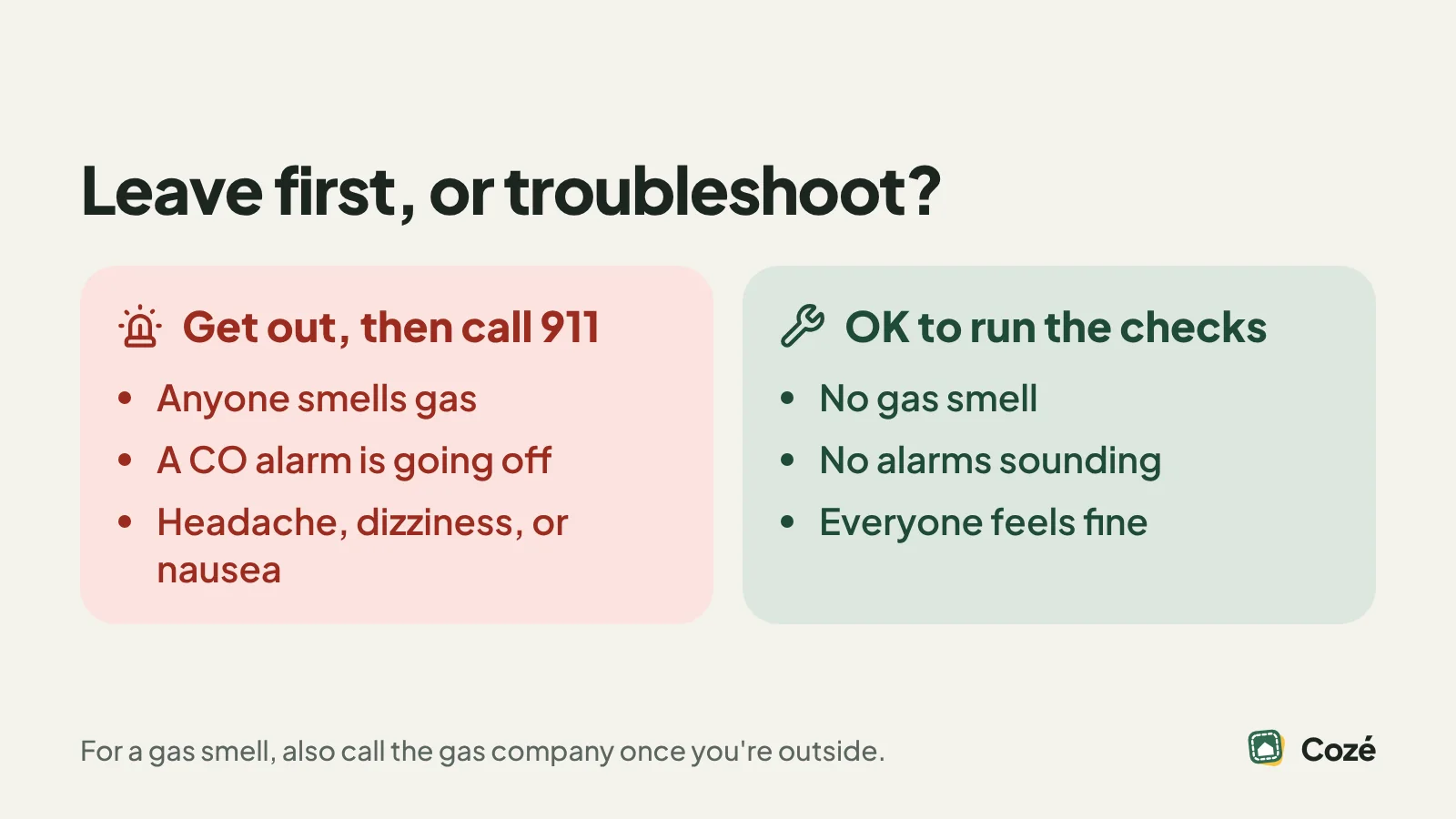
Carbon monoxide can't be seen or smelled. The CDC lists headache, dizziness, weakness, upset stomach, and confusion among the symptoms, and not everyone gets all of them. Treat every CO alarm as a true alarm until the fire department tells you otherwise.
In a multifamily building, Minnesota requires the owner to install a working carbon monoxide alarm within 10 feet of each room used for sleeping, and the tenant keeps it working while they live there (Minn. Stat. 299F.51). October is a good month to test them.
Five-minute checks the tenant can do
If nobody smells gas and no alarm is sounding, walk the tenant through a few checks over the phone or on a video call. Stick to things anyone can do safely.
- The thermostat is set to heat, a few degrees above the room temperature.
- The thermostat screen is on. A blank screen often means dead batteries.
- The furnace power switch is on. It usually looks like a light switch, on the wall near the furnace or on the furnace itself.
- The breaker for the furnace hasn't tripped.
- The filter isn't caked with dust. A badly clogged filter can make some furnaces overheat and shut down.
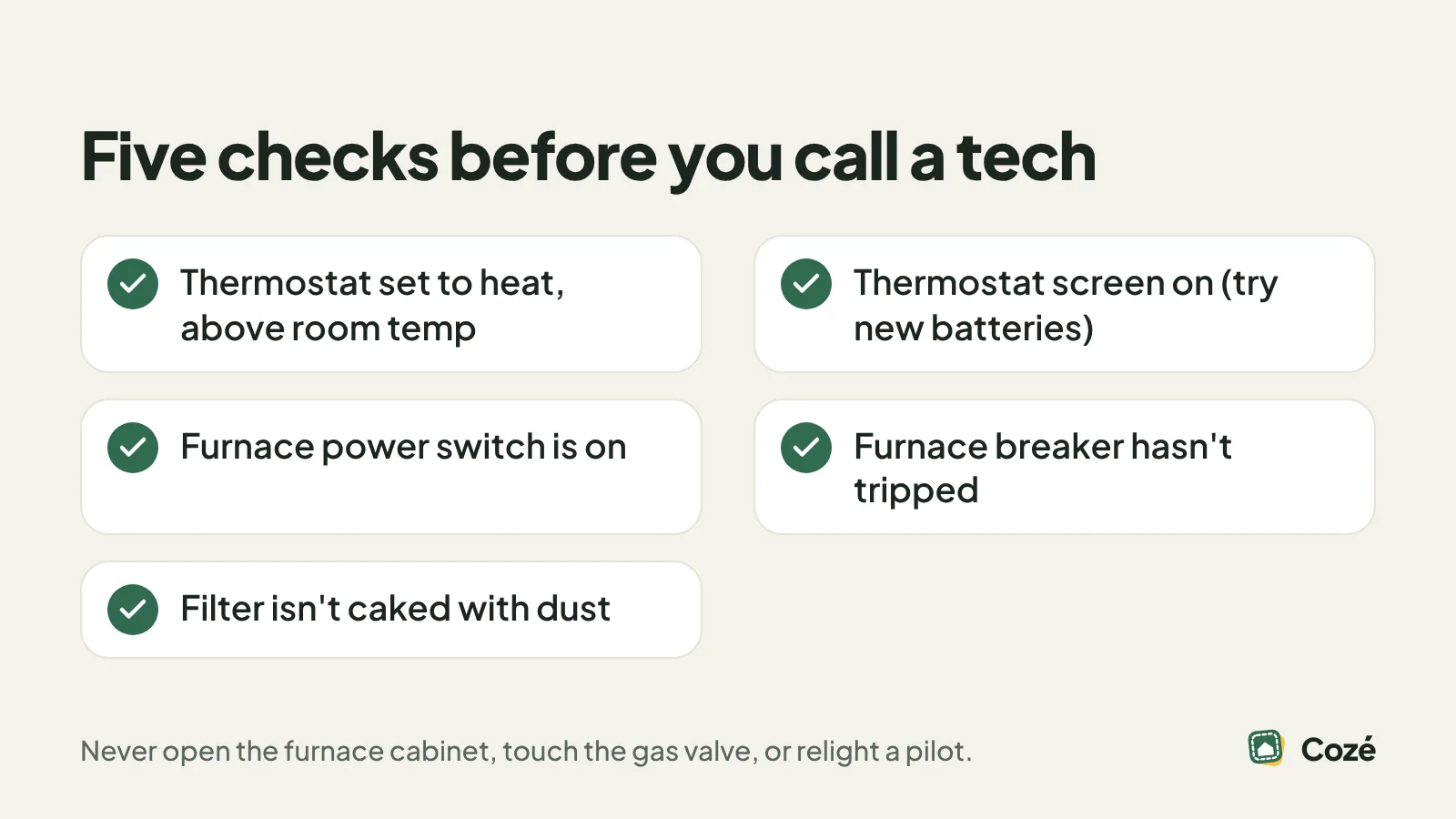
Don't ask a tenant to open the furnace cabinet, touch the gas valve, or relight a pilot. If these checks don't bring the heat back, you're past what a tenant should handle, and it's time for a licensed HVAC tech.
What Minnesota law expects
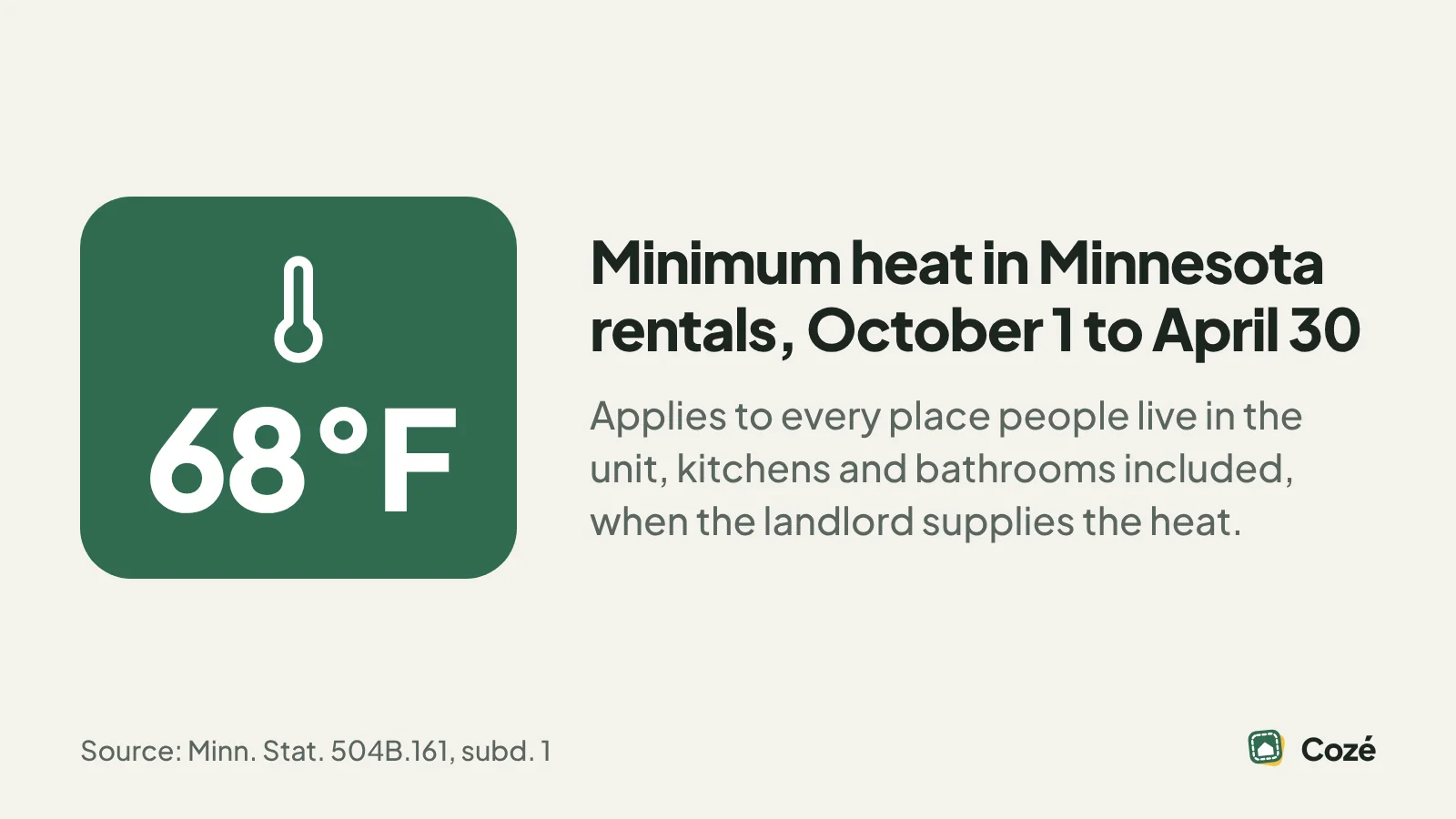
Minnesota landlords who supply heat have to keep every place people live in the unit, kitchens and bathrooms included, at 68°F or warmer from October 1 through April 30. The statute's one exception is when a utility company requires and instructs that the heat be turned down (Minn. Stat. 504B.161, subd. 1). The rule took effect statewide on January 1, 2024. Some cities have their own heat rules on top of it, so check your city's rental code too.
Loss of heat is also on the list of emergencies in Minnesota's emergency tenant remedies law. After trying to reach the landlord at least 24 hours ahead, a tenant can ask a court to order repairs to start right away (Minn. Stat. 504B.381). The simplest way to stay well clear of that is to answer fast, give a time, and keep a record.
Make the repair call
When you call your HVAC company, have the details they'll ask for. The furnace make and model, roughly how old it is, what the tenant already checked, and whether a light on the furnace is blinking. A photo of the label and the blinking light can save the tech a guess, and sometimes a second trip.
Then tell the tenant who's coming and when, even if the answer is "tomorrow between 8 and noon." A cold evening is easier to sit through when there's a time attached to the end of it.
If the wait runs overnight, plan for how the tenant stays warm. Some landlords drop off a space heater. If you do, pass along the U.S. Fire Administration's basics. Set it on a firm, level surface at least three feet from anything that can burn, and plug it straight into a wall outlet, never an extension cord or power strip. Never suggest an oven, a grill, or a generator for heat. The CDC says generators belong outdoors, at least 20 feet from windows, doors, and vents. When it's bitter cold and the part is days out, a hotel night can be cheaper than frozen pipes.
Write it down
Keep a short record as you go. When the tenant reported it, what you checked together, when you called the tech, when they showed up, and what they fixed. Put the invoice with it. If there's ever a disagreement about how long the heat was out, that record answers it, and you'll want it again at tax time.
Before the next cold night
A fall furnace tune-up, a fresh filter, and a tenant who knows where the furnace switch is will head off a lot of these calls. Save your HVAC company's after-hours number somewhere you can find it at 10pm, and give your tenant a short list of what to check before they call.
If your tenants report repairs through Havio, they can mark a problem as an emergency and add photos when they send it, and you get an email about it. You can send the job to your HVAC company from the same request.
Sources
- Minn. Stat. 504B.161, subd. 1, Covenants of landlord or licensor, Minnesota Office of the Revisor of Statutes. Checked October 27, 2026.
- Minn. Stat. 504B.381, Emergency tenant remedies action, Minnesota Office of the Revisor of Statutes. Checked October 27, 2026.
- Minn. Stat. 299F.51, Carbon monoxide alarm requirements, Minnesota Office of the Revisor of Statutes. Checked October 27, 2026.
- When is my landlord required to turn the heat on?, HOME Line. Checked October 27, 2026.
- What should you do if you smell natural gas?, CenterPoint Energy. Checked October 27, 2026.
- Carbon monoxide poisoning can be deadly, Centers for Disease Control and Prevention. Checked October 27, 2026.
- Portable heater fire safety, U.S. Fire Administration. Checked October 27, 2026.
General information, not legal or tax advice. Rules differ by state and city, so check yours or talk to a local professional before acting on it.